2. Click the login button located in the upper right corner.
3. On the login screen, select the PRIMARY USER option.
On the login screen, select the Login with KAÜ button within the Primary User option.
To zoom in, please click on the image.
4. On the login screen, select the PRIMARY USER option.
Enter your client gateway username and password, then click the Login button.
5. Company selection
Scroll down to the bottom of the page with your mouse, then click the “Open” link next to the selected company in the Taxpayer-User Relations section.
To zoom in, please click on the image.
6. Users
After successfully selecting the company, choose the "Users" menu item from the main menu and click on it.
7. New User
On the Users page, click the New User button.
To zoom in, please click on the image.
8. Add User
On the “Add User” screen, select the -> Technical User option.
To zoom in, please click on the image.
9. Adding a technical user
On the technical user addition screen, enter a password for the user, then re-enter it for confirmation. Set the user permissions at the bottom of the page and click the Save button.
10. Details:
The system has created a new technical user. You can copy the username by clicking the “Copy” button.
To ensure data exchange between the software systems, you will need additional keys. To create the keys, click on the “Key Generation” menu item.
To zoom in, please click on the image.
+1 We are done!
The Online Invoice system has created the XML signing key and replacement key.
Copy and note down these keys, as they will be needed for setting up the connection between the software systems.
Finally, click the Modify button, select Edit Profile Information in the quick menu, and then click Save.
By clicking the Back to Previous Page button, you can repeat the above steps to create additional technical users.
BiPPo – Panel Cutting Optimization Program - Update
Our panel cutting optimization program has been expanded with new features. Thanks to this update, we have achieved our 2021 goal of replacing our old box packing optimization program and creating the first Hungarian furniture panel cutting web application. The task was not easy, but we managed to accomplish it. We will continuously transfer the functionality of our old software into the current web solution and, of course, we will strive to implement the constantly incoming customer requests as quickly as possible.
Panel cutting program - Optimization direction can be set
After the update, you can set whether the optimization is done across the board or along the length of the board.
Board Cutting Program - Does the board grain direction matter?
In the board cutting program, if the “Does grain direction matter” checkbox is selected, the elements will not be rotated, even if rotation was previously allowed for those elements. Naturally, if the user leaves the checkbox unchecked, rotation of the elements within the board is permitted.
On November 19, 2021, the first module of our BiPPo panel cutting optimization program, VG Export, was launched. We know that many of you have been waiting for it, so before the web version of BiPPo is released, we have published it for you. The good news is that the module can be purchased separately now at an introductory price of 39,990 HUF.
The organization submitting the application: Székkutas Municipality. Székkutas is located in the northeastern part of Csongrád County, on the border of Csongrád and Békés counties, approximately 45 km from Szeged and about 50 km from Békéscsaba. The village is intersected by Route 47, which connects Szeged and Békéscsaba.
The implementation of the project involves not only Székkutas Municipality but also 17 other regional settlements. These are: Ambrózfalva, Apátfalva, Csanádalberti, Csanádpalota, Földeák, Királyhegyes, Kiszombor, Kövegy, Magyarcsanád, Makó, Maroslele, Mártély, Mindszent, Nagyér, Nagylak, Óföldeák, and Pitvaros.
Rónay Mansion, Apátfalva
The project, prepared with the involvement of numerous affected towns, has significant regional impact and support, enabling the realization of a comprehensive cycling tourism development in the eastern part of Csongrád County.
The area affected by the development is characterized by prominent natural values such as the Maros and Tisza rivers, Körös-Maros National Park, Maros mudflats, and Mártély Landscape Protection Area. The region is interwoven with hiking and cycling routes, and the flat terrain typical of the Great Plain makes pedestrian and cycling tourism easy.
Active recreation is becoming increasingly popular, but its infrastructural background needs to be established. Most of the pedestrian and cycling paths are developed, covering the region network-wise. Towns are increasingly attracting visitors with appealing attractions, and more and higher-quality accommodations are being built.
Cycle the Great Plain - Project Aim
Rotunda, Kiszombor
The primary goal of the project is to develop the cycling infrastructure in the region between the Tisza and Maros rivers. An indirect aim is to seize the opportunity to showcase the natural values and sights of Csongrád County, between the Tisza and Maros rivers, which in many cases are still virtually untouched, to as many people as possible, including younger, family, and older generations.
To encourage them to engage in outdoor activities, actively relax, explore the beauty of the landscape, visit nearby attractions, and stop by a local specialty restaurant or café in the town square.
Cycle the Great Plain – Cycling Rest Areas
As part of the application, we will establish 18 cycling rest areas within our construction activities. Information boards will be placed at these rest areas, thus achieving the development of a cycling route direction signage system in 18 cases.
At the rest areas, we will also provide space for the secure placement of bicycles, meaning the cycling parking infrastructure will be developed.
Great Hungarian Plain
The Great Plain is the westernmost part of the Eurasian steppe region, covering an area of approximately 100,000 km² (of which 52,000 km² falls within present-day Hungary). The current landscape of the Great Plain was shaped by rivers and wind. The rivers deposited alluvial cones and thick sediments along their abandoned channels at the foot of mountain ranges. Examples include Nyírség, Kiskunság, Mátra foothills, and Bükkalja. From the alluvial cone material, the wind accumulated sand (e.g., Kiskunság; Nyírség) and spread a thick loess cover elsewhere (e.g., Mezőföld; Bácskai loess ridge; Hajdúság; Maros-Körös plain; Nagykunság).
Climate Generally, in flat terrain, the average temperature decreases by about 1°C for every 145 kilometers traveled north. Therefore, the average temperature in Baja is 1°C higher than in Budapest.
Flora and Fauna The Great Plain is home to many birds, reptiles, and amphibians, with vegetation predominantly consisting of grains and plants found around lakes and in wetlands. The region is particularly famous for the Grey Cattle, which is mainly bred in the Great Plain, especially in Hortobágy.
Festivals and Events
The portfolio of Great Plain wines is composed of three regions: the 14,000-hectare Csongrád wine region, the 15,000-hectare Hajós-Bajai wine region, and the 104,000-hectare Kunsági wine region. These regions are characterized by a varied and extreme climate, with drought-prone summers and harsh winters. The soil composition is uniformly calcareous sand, originating from the Danube.
Hagymatikum, Makó
In the Csongrád wine region, loess and drifting sand are common, with very low humus content. These conditions had a beneficial effect during the phylloxera epidemic of 1875, as they helped preserve the local vines from the disease. Originally, the vines were planted in these areas to stabilize the drifting sand.
The characteristic grape varieties of this region include Kövidinka, Cserszegi Fűszeres, Kékfrankos, Olaszrizling, and Kadarka. Wines made from these varieties are generally known for their softness compared to wines from other regions in the country, featuring milder acids and appealing to consumers with their spicy and floral aromas.
Great Plain Gastronomy
The Great Hungarian Plain is the largest geographical region in Hungary, covering 56 percent of the country’s total area. As a result, there are significant variations across the Great Plain in terms of dialects, customs, and gastronomy. In this vast area, not only do the ingredients used differ, but so do the cooking techniques and the names of the dishes.
Eszterlánc-tájház
Application
The map, available in both online and offline modes, marks attractions, service providers, shops, dining establishments, and accommodations along the 18-town connecting cycling tour route with precise addresses and opening hours. By downloading and using the application, users can explore the tourist attractions of the towns along the cycling route, and it also helps find grocery stores, accommodations, gas stations, and service centers.
You can also record your tour or capture your current location. If you get slightly lost and are unsure of which way to go, the compass feature can assist. Additionally, you can measure your speed. The application also includes program and tour recommendations alongside these features.
Termicon – Awaiting its partners on a renewed website
The termicon.hu has been updated!
We are proud that companies and businesses in Csongrád-Csanád County are able to achieve success by supporting each other.
Sowolu Ltd. entrusted us with the task of creating a website that meets the current professional standards.
The company’s expectation was that the website should be easy to maintain and, in addition to containing a lot of information about the company’s products, it should also have a beautiful and clean design.
When designing the menu system for the Termicon website, it was important to ensure that users could quickly access the relevant information. Since most users now browse from mobile phones, we designed the website to be responsive.
Approximately 40% of companies are unable to recover and restart after a potential IT disaster…
Currently, we use many systems whose background we do not know. We do not know the source code, the creator, or the infrastructure, and we use them daily simply because they work at the moment. But think about it: what guarantee is there that they will work tomorrow and the day after?
Have you ever considered how much it would cost to restore the entire company’s IT in the event of a disaster?
Have you ever considered how many days it would take to restore IT?
In the case of a large bank, the cost would be approximately 3 billion forints and it would take around 10 working days.
Prevent IT disaster
Perhaps never before has it been so timely for a company leader to consider creating a Disaster Recovery Plan. Our company’s managing director’s sole proprietorship has been providing this service to companies and businesses since November 2017.
In the current situation, the Disaster Recovery Plan can be of great help by preparing companies for what will happen if, for example, the system administrator falls ill, a server goes down, or there is no one available to operate the IT infrastructure.
Currently, many people are working from home, but if the IT system goes down and they cannot access the company’s shared documents and data, they will not be able to work despite their willingness to do so.
This is why it is crucial to pay special attention to how we respond at the company level when a particular event occurs.
We are facing a complex problem, but we feel that with the experience gained over the past years, we can prepare our partners to get through this period without an IT disaster.
Ensure that your applications function when you need them the most.
The Disaster Recovery Plan provides assistance in ensuring,
by outlining a scenario for you,
that includes recovery solutions and protects
and supports continuous company operations.
Testing, Verification
It is very important that even if you already have a disaster recovery plan, it is recommended to review, test, and, if necessary, supplement and update it.
The plan is a document, but it is crucial that everyone involved knows and applies its contents. That’s why it’s important to test, test, and test again, and to measure the test results so that as company leaders, we are always aware of the time required for a smooth IT recovery.
If we are not satisfied with the time achieved, we should optimize and further explore the possibilities for automating the recovery process.
Our Services
Disaster Recovery Plan Development
Restoring or rebuilding the entire functionality of the company’s IT system
Review
Reviewing, supplementing, and updating an existing plan.
Testing, Verification
Testing, verifying, and measuring the application of the plan’s provisions.
Long-term software security
With our service, you can keep your software secure…
Deposit:
Any developer source code for business-critical applications
Software specifications
Descriptions and documentation
Executable files
Configuration files
Backup information stored in the system
When should you immediately use our service?
If you cannot afford for your operations to come to a halt due to software issues
If you assess the developer risk as too high
If you see that the full functionality of the software you use may not be ensured in the future
If a partner company’s unexpected event (such as bankruptcy or a virus) could put your company at risk
For more information about the service, click the image...
Choose the Free package and try our solution without any commitment.
Step 2
Set the scanner’s save folder to the folder created for the invoices to be processed, so all you need to do is scan the paper invoices. From there, the data will automatically be transferred into the accounting or document management software.
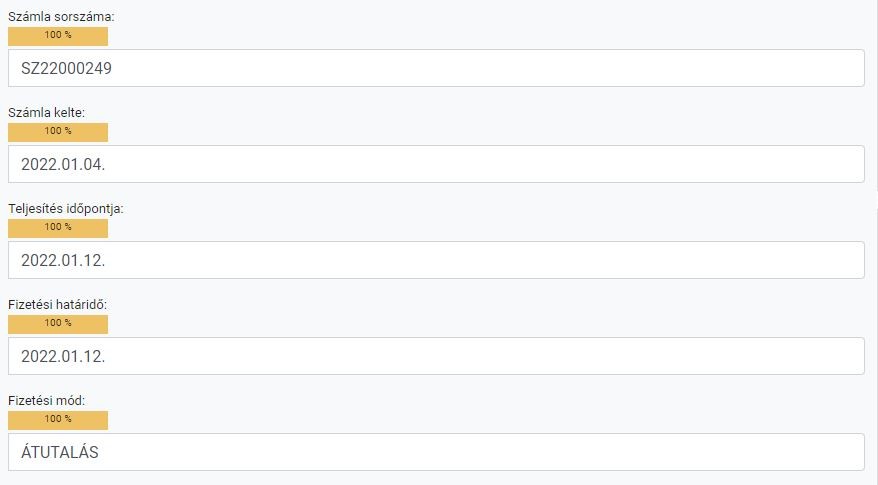
From our video, you could see that you can automatically extract all essential invoice data: seller, buyer, invoice date, payment deadline, performance date, payment method, total gross amount payable, net amount, and VAT.
With the automated extraction of data, manual work can be almost entirely eliminated!
With the use of OCR, you no longer need to type; you only need to verify the scanned data.
Additional advantages of OCR
Automatic Invoice Processing – Intelligent, Accurate, Fast
Hungarian language support
High accuracy
Ease of use
Technical background
ext recognition occurs in the cloud, so it does not require local resources.
File transfer is SSL secured.
Files are deleted from the cloud after processing.





 Corporate problems…